

Elmer Ray Black 1918-2004

Elmer Ray Black was born on April 29, 1918 with his twin sister Erda
Ruth, to Samuel Hodgson and Flora May Lancaster Black. They were numbers 9 and 10 in the family, with one more child to follow in 1921, Zenith Gene. He was a Word War II Navy veteran, and served aboard the USS Kennebec, USS Billy Mitchell, and LST-822 in both the Atlantic and Pacific theaters of war from 1942-1946.
It is estimated he graduated from high school, probably McKeesport High, around 1936, working as a candy truck driver in McKeesport until going into the Navy in 1942. 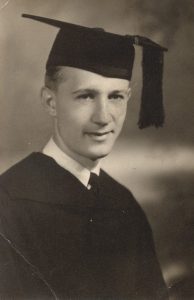 He was first married to Betty, with whom he had one child, Bobby. He re-married once more to Thelma, who died in 2002.
Around the year 2001, I had many telephone conversations with him about what he remembered about our ancestors, and about his service to our country. The following is from a letter he sent me, documenting what he remembered:
Elmer Black’s Recollections of His Service in the Navy During World War II in His Own Words

I spent 44 months in the Navy.
I boarded the U.S.S. Kennebec, A.O. (oiler-tanker) in Norfolk, VA in June 1942.
Norfolk, Virginia was our home port: in-out, out and in. We made so many trips to Houston, Texas- Port Arthur, etc., for oil. A day or two later, heading for Norfolk, VA; New York City; Boston, Mass.; Bangor, Maine; Argentina; Newfoundland, up and down the East Coast to Texas to Newfoundland. Seven trips (were made) to Hamilton Beach, Bermuda, Aruba Island north of Venezuela, South America. Back to Norfolk, Va., to Texas, up and down the East Coast- umpteen times.
Finally the Big Day came: November 1942. We leave Norfolk, Va., heading slightly southeast. All kinds of ships, tankers, destroyers, battleships, and I believe an aircraft carrier. The convoy is forming. We do not know our destination until 24 hours later: Casablanca, Africa, French Morocco. Ships galore: a hundred and more. Never have I seen a convoy of ships so large in number.
After two weeks or so, Casablanca was secured. Headed for Norfolk, Va. About midway back, we witnessed a burial at sea: two bodies from the ship dead ahead of us returning the wounded.
We made four or five more trips to Casablanca and back, one trip to Dublin, Ireland and Glasgow, Scotland. (We) left Scotland (and traveled) a night through a minefield: eerie feeling heading for Norfolk.
(It was) getting boring: when is this blame thing going to end? We were on a standby notice in Newfoundland June 6 when the Allies invaded Europe. In the meantime, I’m asking for a transfer everywhere we went. Finally (I) transferred to Chicago Amphibious Craft, Landing Craft L.S.T., Landing Ship Tank 822. We launched this ship in Evansville, Indiana November 23, 1944, down the Mississippi River to New Orleans, La. After shakedown off Florida coast, we ran aground on a sand bar for three days. Finally a tug pulled us free. (We) departed New Orleans for the Pacific on December 27, 1944.
(We) went through the Panama Canal to Los Angeles, San Francisco, Calif., under the Golden Gate Bridge out into the Pacific. I believe we were 40 days getting to the Hawaii Pearl Harbor about February 6, 1945.
Now we are hopping from one Island to another: Marshall Islands, Marianna Islands to Bioko, just north of New Guinea (south of the equator), and wound up (on) the Philippine Islands: Manila (P.I.), Leyte (eastern P.I.), Luzon (northern P.I.), Subic Bay (P.I.). We ran six or more times from the Philippines to Okinawa Island (about 600 miles south of Tokyo, Japan), back and forth. In the meantime, while in Naha Harbor, Okinawa, we are air raided 18 days out of 33. (There was) constant bombing, air raids every 6 hours or so. (It was) boring also. I wanted to go home. The destroyers anchored on the outskirts of the harbor (Naha Harbor, Okinawa), (and) took a beating. (There were) kamikaze pilots , suicide pilots: one crashed into a hospital ship killing a female Lt. nurse from Hazelwood, Pittsburgh, PA.
One my last trip to Okinawa, I was going on watch. I manned a 20mm gun and our radioman and I conversed 5 minutes. He told me they were (U.S.) going to drop a bomb on Japan. It was to be the biggest and most destructive of all the bombs dropped from all over the world combined. I could not visualize a bomb so huge and destructive. I’m thinking hurry and drop it, still wanting to go home.
Back to the Philippines again. I took sick near Manila, P.I., and had my appendix removed. I was transferred off the ship with all my belongings (sea bag and all) about a week later. My ship, L.S.T. 822, was back in harbor. I was told they are going to Japan. I was high above the harbor, looking down and could see the ship. I had the option of going back aboard to Japan or go home. I chose home.
Finally late November I boarded the Billy Mitchell, troop ship, and headed home. Bunk beds (were) 5 high. December 4, we crossed the International Date Line, heading east. We had two December 4th. (We) arrived in San Francisco. (I was) so glad to be in the U.S. (I) took a train home to Sampson Base, N.Y. (We) had 2′ snow going through Buffalo, N.Y.
(I was) finally discharged late December- early February, 1946. I did not keep a diary of dates and happenings. I recall most. I received two battle stars, one in each theatre of operations: one for European-African Theatre, one for Asiatic-Pacific theatre, Casablanca, Okinawa.
Casablanca was the first offensive, 1942 operation of the European War. Okinawa was the last offensive, 1945 operation of the Pacific War.
I was home several months and come down with Malaria. (I was) sick, real sick (with) headache, nausea. While in Manila, I slept in a Quonset hut, no mosquito protector, and nights were terrible.
Spotting Brother Gene’s Ship
When approaching Saipan, I was on watch on top of the bridge. I spotted ships anchored out in the harbor. I recognized repair ships, etc. I asked the bridge to verify if Gene’s ship, USS Hector #7 was amongst them. Sure enough within two minutes I had my answer.
The USS Kennebec
The USS Kennebec, AO #36, was put in dry dock for 17 days. (We) had radar and a 5 inch gun on the stern installed. What a transformation with the radar, like watching black and white TV. All the ships were seen at one time. These were silhouettes. If one ship got too close or out of line, they were notified and made corrections. On one trip returning from Houston, Texas, we had no escorts (first and only time). The radar picked up a ghost signal to our rear. We usually cruised at 10-11 knots. The captain called for full speed ahead. We ran most of this way to Norfolk. German submarines were in the Gulf of Mexico also.
Two Episodes or So
While going to Casablanca, an ammunition ship on our port side, left side, was slowly creeping towards us, we were going about 12 knots speed. Our captain radioed for full right rudder, full speed ahead to avoid a collision.
While returning from Casablanca the first time, we sang the song ‘Anchors Aweigh’ and fueled the Coast Guard destroyer for depth charging and sinking a German U-boat submarine. They exchanged guns, handguns, captured officers of both ships.

Thank you for your service, Uncle Elmer. You are not forgotten.